A Launchpad for Kids, A Lifeline for Parents
The Real Stories Behind Michigan’s PreK for All Initiative
For Lansing parent Brittany Gibbs, the feasibility of child care came down to a question no working parent wants to ask: Is it worth having a job if most of your paycheck goes toward paying someone else to care for your children?
With two children under age 2 at the time, Gibbs’ family faced an estimated $1,600 a month in child care costs. Eventually, they decided her husband would stay home with their children.
“One of our paychecks would solely go to child care,” Gibbs said. “We thought, ‘This isn’t worth it to work just to pay for daycare, right?’”
Even when Gibbs worked from home and her family grew to four children, reliable care remained out of reach.
“You could find me hidden in a small back bathroom at times where the kids would be napping in their cribs, trying to carve out time to work,” she recalled.
A Workforce Issue
Gibbs’ experience illustrates a broader reality: Access to child care can directly affect a family’s ability to work and advance in a career. In the Capital Region, 41% of a minimum-wage family’s income goes toward child care, while the average cost of center-based care is $10,568 per year.
The economic consequences extend beyond family budgets. A 2025 study found that families living farther from licensed child care providers were less likely to participate in the workforce. What’s more, child care access-related disruptions cost Michigan $2.88 billion annually, including $2.3 billion in employer losses and $576 million in lost state tax revenue.
The Financial Impact of PreK for All
For Gibbs, PreK for All eventually changed that equation.
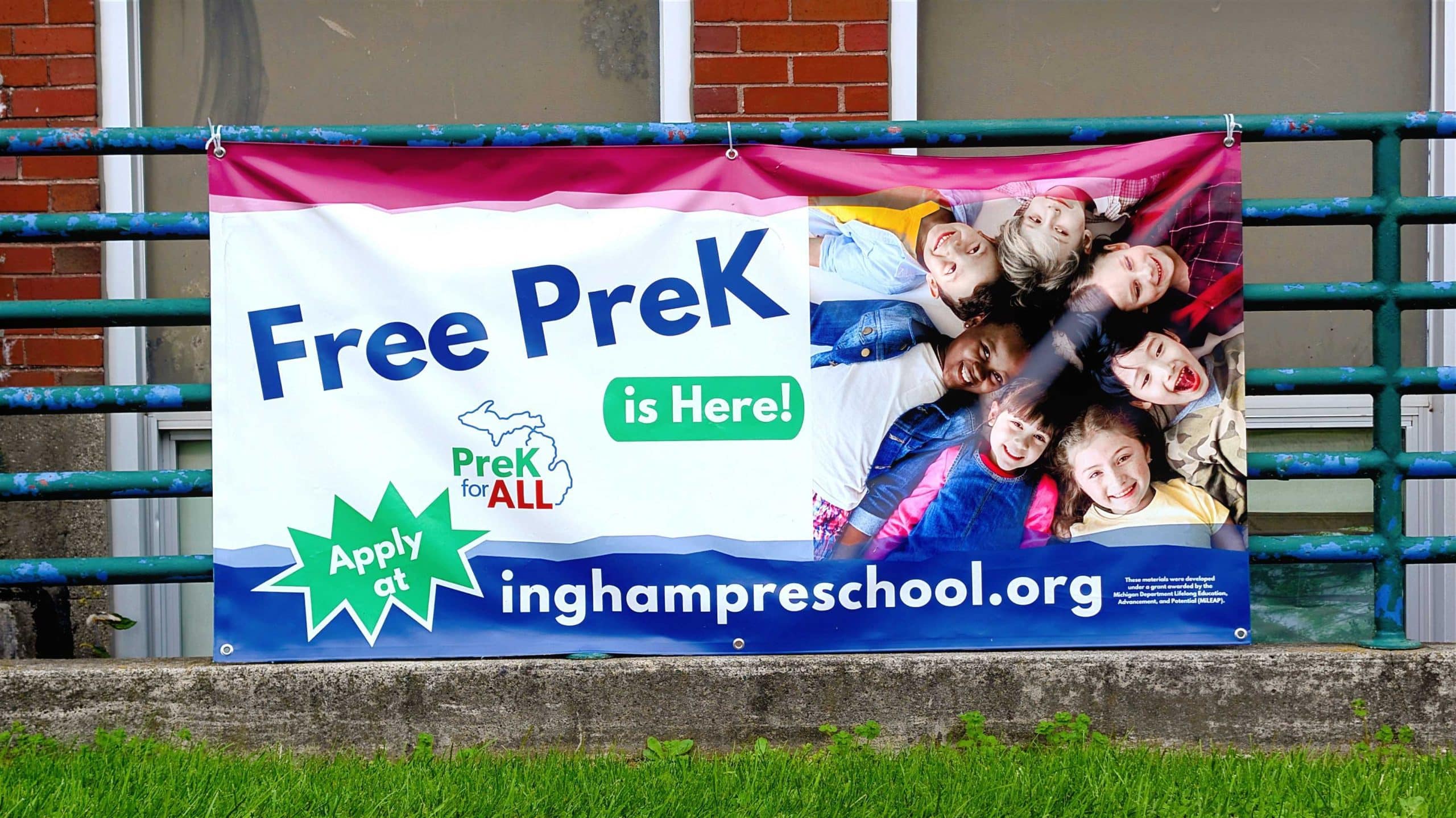
Michigan’s PreK for All initiative provides no-cost early learning opportunities for 4-year-olds through several programs and settings, including the Great Start Readiness Program (GSRP). GSRP is the state’s primary state-funded PreK program. As of January 2026, nearly 55,000 children were enrolled in GSRP statewide, more than twice the number served in 2021. The state estimates that PreK for All can save families about $14,000 per year in child care costs.
After enrolling her daughter in a PreK for All program through Lansing School District, Gibbs was able to take on more responsibility professionally. She began her career in an entry-level position and eventually advanced three levels.
“Without free PreK, there’s no way that I would have been able to do what I’m now doing in my career,” she said.
For Alison Soderberg, a kindergarten teacher at Webberville Elementary and mother of three, free PreK has also helped make the practical realities of being a working parent possible. Two of her children have attended the PreK for All program with Little Spartans Preschool at Webberville Elementary.
“Having five-day-a-week care available during my workday has been a huge, huge blessing for my family,” she said.
The financial difference has also been significant. Soderberg estimates that her family saves at least $10,000 per child for each year they participate in PreK.
“With three kids, we’ve been able to use those savings to put the kids in sports and after school activities,” she said. “We’ve also saved more for family vacations that we wouldn’t have normally considered.”
Social and Educational Benefits for Students
The value of quality child care isn’t only measured in dollars. With quality early education, families gain another trusted adult to support their child’s development.
When one of Gibbs’ PreK teachers noticed a potential speech concern in her daughter, she brought it to the family’s attention. That prompted them to seek additional speech support.
“That flag in itself was a life-changing moment,” Gibbs said. “Our child care teachers are a part of our village. They’re the people looking out for our kids.”
Soderberg sees that same impact from the other side of the classroom. As a kindergarten teacher, she has a unique perspective on how PreK can affect students’ educational, social and emotional development. With 16 of the 18 students in her current kindergarten class having participated in PreK, she says she can see a clear difference.
“A lot of the kids that come from PreK have a leg up, I feel. They arrive already comfortable being away from their parents, navigating classroom routines, following directions and interacting with other children,” Soderberg explained. “Many of these kids bring a good foundation on their alphabet, numbers and writing their name. This just makes kindergarten so much easier.”
Research supports those observations. A 2024 study found that GSRP participants performed better on Michigan’s Kindergarten Readiness Assessment than children who were waitlisted because their local program was full. The researchers also found that GSRP participants were less likely to be absent during kindergarten.
Michigan’s Free PreK initiative also has a longstanding focus on program quality. For the ninth consecutive year, it met all 10 quality benchmarks established by the National Institute for Early Education Research, including standards related to curriculum and teacher qualifications.
Building a Stronger Child Care System
Access to quality child care hinges on having high-quality programs and educators, along with the capacity to serve the families who need them. The Capital Area Child Care Coalition exists to help make that possible.
The Coalition brings together child care providers, community organizations, educators, government officials and other local partners to address child care challenges across Clinton, Eaton and Ingham counties. Its work focuses on strengthening the regional early care system, supporting providers and identifying ways to expand sustainable access.
The need remains significant. In the Capital Region, 77% of local child care providers report staffing shortages, and there are five children under age 2 for every available infant care spot.
Soderberg experienced that demand firsthand.
“When I worked in daycares, it was difficult to staff our team with the same people,” she said. “It was hard on the kids not to have the same, consistent caregiver every day.”
The Coalition aims to address these issues through funding opportunities, business and technical support, workforce development and regional planning. With 74 Coalition members across sectors, regional groups help develop community-based solutions that expand access to quality, affordable care. By joining the Coalition, members contribute to conversations that help shape a stronger early childhood system for the Capital Region.
The Ripple Effect of a Strong Start
Research and economic data demonstrate the broader importance of child care. But sometimes, it’s easier to see this impact in a 3-year-old strutting down a school hallway.
Over the course of her son’s PreK program, Soderberg saw her son, Drew, evolve from somewhat shy into an enthusiastic learner. By the end of the school year, he would march himself to his own classroom, excited for the day.
When Soderberg reminded Drew that they still needed to walk in together and sign in, he replied, “No, Mom. I’m ready to go.”
Quality, accessible child care equips children with the confidence, independence and academic foundation to succeed. On a statewide scale, those individual gains add up. With a stronger early childhood system, we can uplift children and families today while helping build Michigan’s strong workforce and communities of tomorrow.
About the Capital Area Child Care Coalition
The Capital Area Child Care Coalition (CACCC) is a regional partnership working to improve the availability, affordability and quality of child care in Clinton, Eaton and Ingham Counties. Founded in 2023 and co-led by the Lansing Economic Area Partnership (LEAP), United Way of South Central Michigan (UWSCM) and Capital Area Michigan Works! (CAMW!), the CACCC brings together parents, providers, employers and local leaders to identify challenges and implement practical, community-driven solutions.